

The demand for efficient and reliable hot water systems continues to grow across hotels, commercial buildings, residential developments, hospitals, staff accommodation, and industrial facilities in the UAE. With rising energy costs and increasing attention toward energy efficiency, businesses are looking for hot water solutions that can deliver consistent performance while controlling operating expenses.
At the heart of many of these systems are heat pumps and calorifier tanks. While the final equipment may look simple from the outside, producing a reliable system involves careful engineering, quality materials, precision fabrication, component assembly, testing, and inspection.
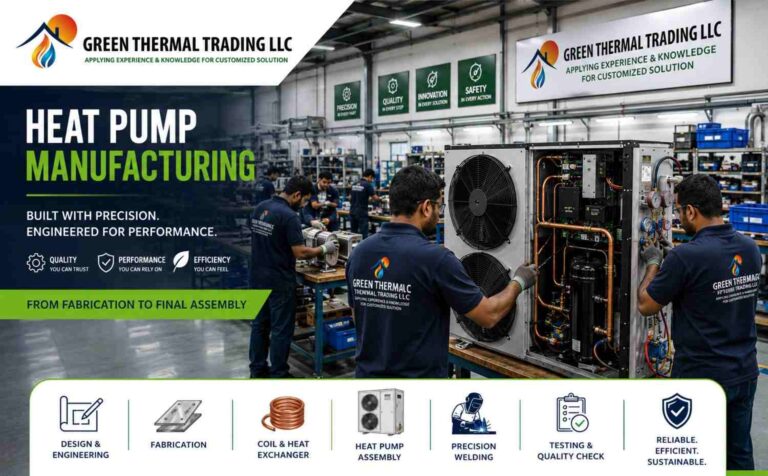
As a Heat Pump Manufacturer in UAE, Green Thermal ME focuses on developing and assembling practical hot water solutions designed for the requirements of the UAE market. From calorifier tank fabrication to heat pump assembly and final testing, every stage plays an important role in the performance and reliability of the finished system.
A heat pump is an energy-efficient heating system that transfers heat from one source to another rather than generating heat directly through conventional electrical resistance. Heat pumps can be used for domestic and commercial hot water applications and can help reduce energy consumption when properly designed and operated.
A calorifier is a hot water storage tank designed to store and maintain heated water. It can work together with a heat pump, boiler, solar thermal system, or other heat source. The combination of a heat pump and calorifier can provide an effective solution for properties that require a continuous supply of hot water.
The correct combination depends on factors such as hot water demand, storage capacity, required temperature, available space, application, and system design.
The quality of a hot water system depends on more than the main heating equipment. The tank, internal coil or heat exchanger, connections, insulation, controls, and supporting components all contribute to overall performance.
Poor fabrication or incorrect component selection can result in leakage, heat loss, corrosion, inefficient operation, or premature equipment failure. This is why manufacturing and assembly need to follow a controlled process.
For a Calorifier Manufacturer in UAE, understanding local operating conditions is particularly important. UAE projects can experience high ambient temperatures, demanding operating schedules, varying water quality, and space limitations. Equipment therefore needs to be selected and manufactured according to the specific application.
The manufacturing process starts with understanding the project requirements.
Before fabrication begins, engineers and technical teams consider:
For commercial applications, sizing is particularly important. A hotel, for example, may have significant fluctuations in hot water demand throughout the day. A properly designed storage and heating system helps ensure that sufficient hot water is available during peak periods.
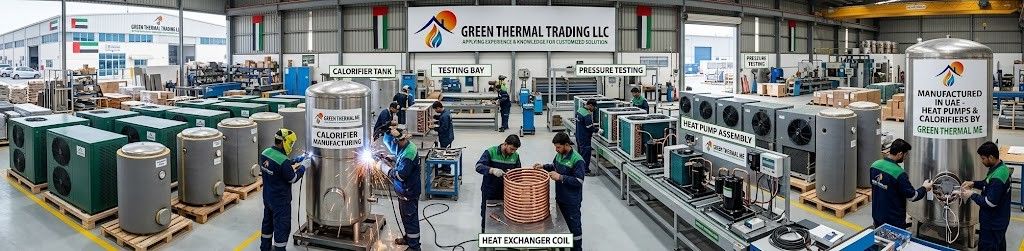
Material selection is an important part of calorifier manufacturing. The material must be appropriate for the intended application, operating conditions, water characteristics, and required service life.
Stainless steel and other suitable materials can be selected depending on the project requirements. Components such as pipes, coils, fittings, valves, insulation, and external panels are also selected based on their function within the system.
Choosing the right materials helps improve durability and contributes to reliable long-term operation.
Once the design and material requirements are finalized, fabrication begins.
The tank body is prepared according to the required dimensions and specifications. Cutting, forming, positioning, and welding need to be performed accurately to achieve the required shape and structural integrity.
One of the most important stages is welding. Proper welding techniques are essential because the tank needs to withstand pressure, temperature variations, and continuous operation.
The internal arrangement of the tank can also include heating coils or heat exchanger components. Their positioning affects heat transfer and overall system performance.
Heat transfer is a critical part of the hot water system. Depending on the design, a calorifier may incorporate an internal coil or heat exchanger through which the heating medium circulates.
The coil needs to provide sufficient surface area for effective heat transfer while maintaining compatibility with the tank and heating system.
During fabrication, attention is given to dimensions, connections, positioning, and welding. Proper installation of the coil helps ensure efficient transfer of heat into the stored water.
For larger commercial systems, multiple heating sources or specially designed heat exchanger arrangements may be considered according to the project requirements.
After the individual components are prepared, the heat pump assembly process begins.
A typical heat pump system can include components such as:
Each component has a specific role in the heating cycle. The components must be correctly positioned and connected to allow the system to operate safely and efficiently.
Assembly also involves checking electrical connections, refrigerant circuit connections, water-side connections, controls, and safety devices.
The heat pump and calorifier can be designed to operate as an integrated hot water solution.
The heat pump transfers heat to the water, while the calorifier provides storage. This combination can be particularly useful for commercial buildings where hot water demand changes throughout the day.
The storage tank provides a buffer, while the heat pump can replenish the stored hot water according to the system’s operating requirements.
Proper integration is essential. Pipe sizing, circulation, controls, temperature sensors, valves, and system configuration all need to work together.
Welding is one of the most visible stages of manufacturing, but it is also one of the most important.
Technicians need to ensure that welded joints are properly formed and suitable for the intended application. Visual inspection and appropriate testing procedures can help identify potential issues before the equipment leaves the manufacturing facility.
Quality checks can cover:
A systematic inspection process helps reduce the possibility of problems during installation and operation.
Before final delivery, the equipment should undergo appropriate testing based on its design and application.
For calorifier tanks, testing can help verify the integrity of the tank and its connections. For heat pumps, testing can include checking the heating operation, electrical components, controls, temperature readings, and other relevant parameters.
Testing provides an opportunity to identify and correct issues before the system reaches the project site.
Once fabrication and testing stages are completed, insulation and external finishing can be carried out.
Good insulation is important because it reduces unwanted heat loss from stored hot water. This is particularly relevant in commercial hot water systems that operate for extended periods.
The final assembly also includes fittings, valves, control panels, covers, labels, and other required components.
At this stage, the equipment begins to take its final form and is prepared for transportation and installation.
Working with a local Heat Pump Manufacturer in UAE can provide several practical advantages for commercial projects.
Local manufacturing and assembly can make communication easier during the design stage and allow equipment to be adapted according to project requirements. It can also support faster technical coordination when modifications or application-specific requirements arise.
UAE-based manufacturing also provides an opportunity to develop solutions with local environmental and installation conditions in mind.
For project consultants, contractors, hotels, and facility managers, having access to a technical team that understands the application can simplify the equipment selection and installation process.
Heat pump and calorifier systems can be used across a wide range of applications, including:
Hotels require reliable hot water throughout the day for guest rooms, kitchens, laundry facilities, and other services. Properly sized heat pump and storage systems can support changing demand patterns.
Office buildings, shopping facilities, and other commercial properties can use centralized hot water systems for washrooms, staff facilities, kitchens, and other requirements.
Large accommodation facilities can experience significant peak demand. Calorifier storage combined with efficient heating equipment can help meet these requirements.
Healthcare facilities have demanding hot water requirements and need systems that can operate reliably with appropriate temperature and hygiene considerations.
Industrial sites may require hot water for processes, cleaning, staff facilities, and other applications. System design can be adapted according to the specific operational requirement.
A successful system is not determined by one component alone. It is the result of correct engineering, suitable materials, quality fabrication, efficient heat transfer, proper assembly, and appropriate testing.
The system should be:
This is why choosing an experienced manufacturer and technical partner is an important part of any commercial hot water project.
Green Thermal ME focuses on providing heat pump and hot water solutions for commercial and specialized applications. The manufacturing and assembly process brings together fabrication, heat transfer technology, equipment assembly, and technical expertise.
From the initial design concept to tank fabrication, coil assembly, heat pump integration, welding, testing, and final inspection, each stage contributes to the finished product.
The objective is simple: develop practical hot water systems that meet the requirements of UAE projects while providing reliable and efficient operation.
Manufacturing a reliable heat pump and calorifier system involves much more than assembling individual components. It requires careful engineering, material selection, tank fabrication, coil manufacturing, heat pump assembly, precision welding, testing, insulation, and final quality inspection.
For businesses looking for a Heat Pump Manufacturer in UAE, understanding the manufacturing process can provide valuable insight into the quality and reliability of the equipment they choose.
With the right design and manufacturing approach, heat pumps and calorifiers can provide an efficient and dependable hot water solution for a wide range of UAE commercial applications. Green Thermal ME continues to combine fabrication and heat pump technology to develop practical hot water solutions designed around the requirements of modern projects.