

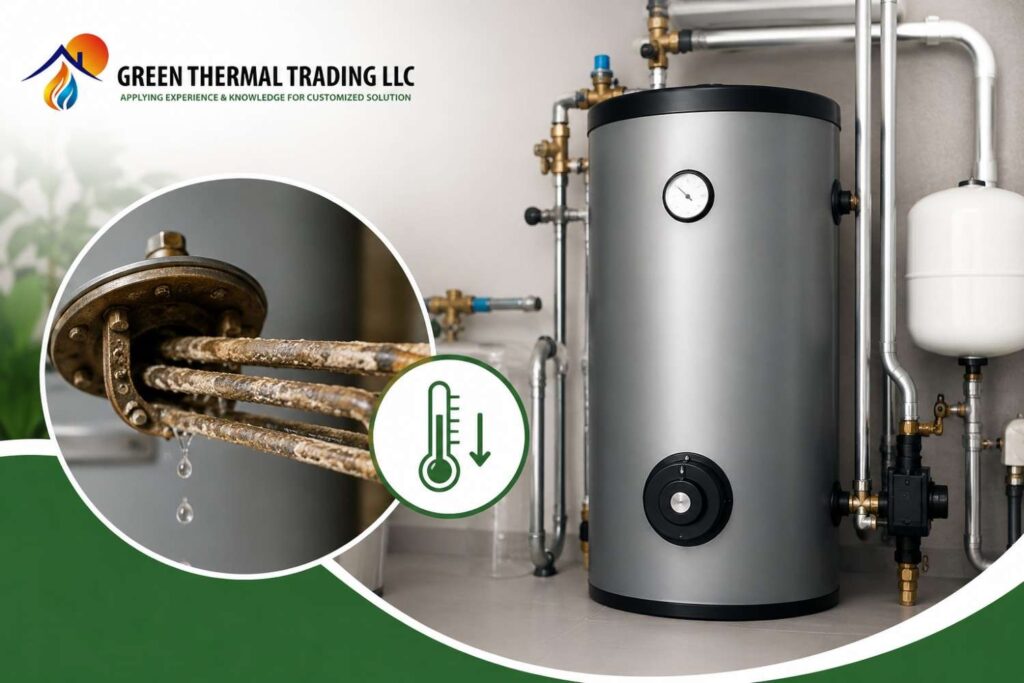
To fix an on-site commercial calorifier or hot water tank leak in a hotel plant room without completely replacing the system, engineering departments must deploy specialized on-site mobile welding or localized epoxy relining. If the structural integrity of the steel vessel is sound, emergency repairs can extend the equipment life. Furthermore, when basement access prevents moving a massive pre-fabricated tank into a tight hotel plant room, engineers can commission fully compliant on-site manufacturing of the calorifier adhering strictly to the European Pressure Equipment Directive (PED).
Why Commercial Calorifiers Leak in UAE Hotels
Hotels across Dubai, Abu Dhabi, and the wider GCC region run their domestic hot water systems under demanding conditions. High ambient entry temperatures, continuous peak-load strain from guest rooms, and accelerated mineral deposition all contribute to early failure. The two primary causes of leaks include:
- Chloride Stress Corrosion: The high mineral content in the region’s desalinated water attacks standard steel joints, leading to micro-fissures around weld lines.
- Galvanic Corrosion: Failure to replace sacrificial anodes on schedule leads to accelerated pitting along the internal lining of the tank.
On-Site Commercial Calorifier Manufacturing and Repair Variables
When assembling a new pressure vessel or repairing an existing system directly inside a hotel plant room, the fabrication must strictly comply with PED 2014/68/EU (formerly 97/23/EC) categorization based on maximum allowable pressure (PS) and volume (V).
| Operational Parameter | PED Manufacturing & Repair Specification |
|---|---|
| Common Tank Materials | High-grade SS316L Stainless Steel or Enamel-Lined Carbon Steel |
| Typical Tank Capacity Range | 300 Litres to 5,000+ Litres for commercial hospitality hubs |
| Design and Pressure Codes | EN 13445 (Unfired Pressure Vessels), BS 853, or ASME Section VIII |
| PED Compliance Mandate | Strict adherence to Sound Engineering Practice (SEP) or Category I-IV CE marking depending on the bar-litre threshold |
| Material Traceability | EN 10204 Type 3.1 or 3.2 material certificates required for all steel plates and shell sections |
| Weld Quality Assurance | Non-Destructive Testing (NDT) including radiography and dye penetrant testing on structural joints |
| Internal Protective Options | WRAS-approved polymer coatings |
| External Insulation Standard | 50mm Rockwool or polyurethane foam with aluminum cladding |
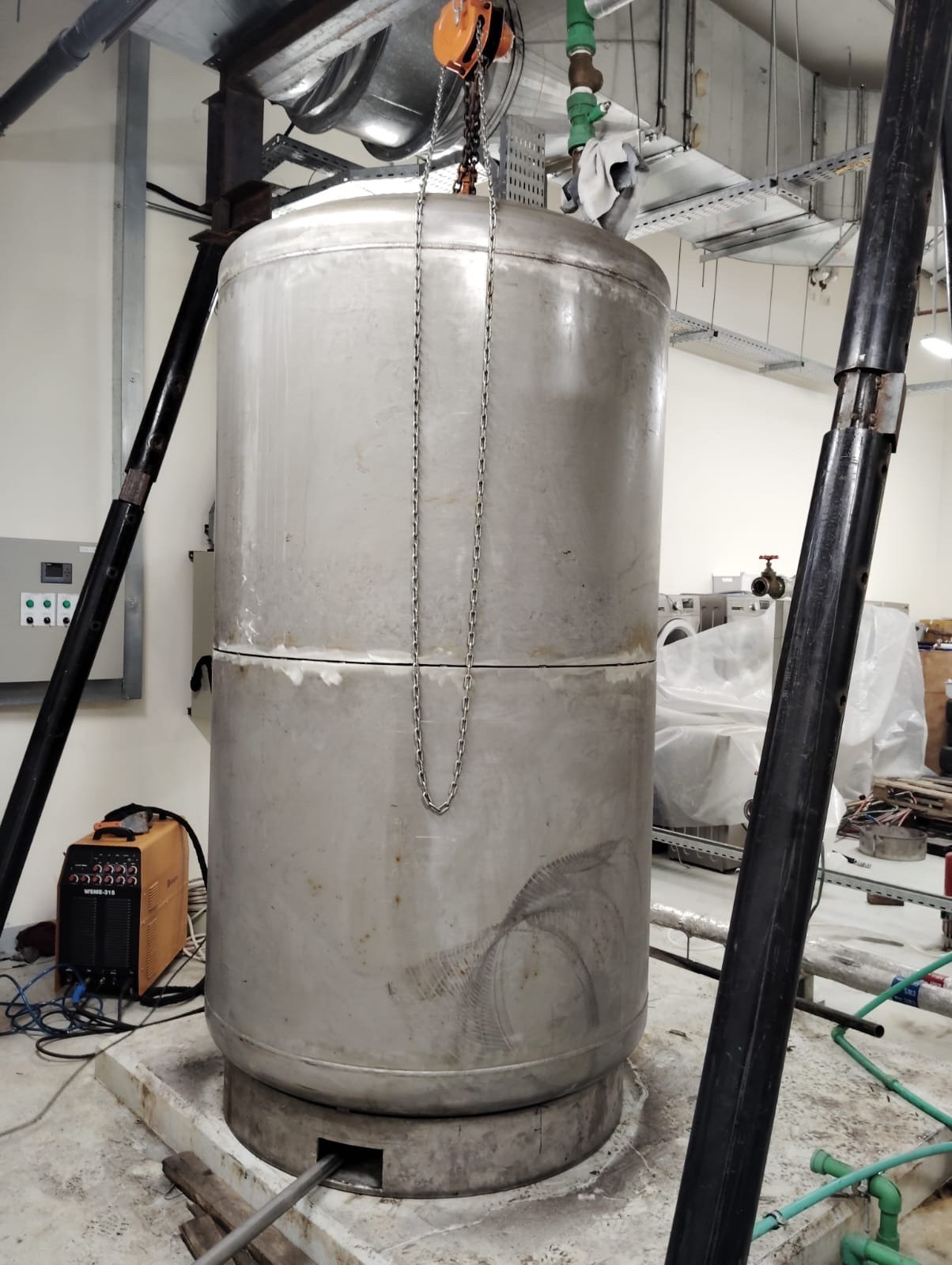
On-Site PED Manufacturing and Assembly Protocol
When restrictive structural access rules out pre-fabricated delivery, the unit is manufactured in modular sections and assembled on-site:
- Precision Component Preparation: Shell cylinders, dish ends, and internal heat exchanger coils are precision-rolled and pre-cut at a local facility using certified PED-compliant steel plates.
- Plant Room Rigging: The compact sections are transported through standard guest service elevators or narrow basements directly into the plant room.
- On-Site Qualified Welding: WPS (Welding Procedure Specifications) and WPQR (Welding Procedure Qualification Records) approved by a European Notified Body must be executed by certified welders using argon-shielded TIG/MIG processes.
- NDT Inspection and Passivation: All structural seams undergo dye-penetrant or radiographic testing to verify zero micro-fissures, followed by thorough chemical passivation processing of the internal SS316L surfaces to restore corrosion resistance.
- Hydrostatic Testing & CE Certification: The final vessel undergoes a certified hydrostatic test at 1.43 times the maximum allowable working pressure. A technical file is generated to grant the final PED compliance rating before insulation.
Frequently Asked Questions
Can a hotel calorifier manufactured completely on-site achieve true European PED compliance?
Yes. On-site manufacturing achieves full European Pressure Equipment Directive (PED) compliance provided that the engineering design utilizes EN 10204 3.1 certified materials, the welders hold valid third-party qualifications, and a hydrostatic proof test is witnessed and documented under a certified quality management system.
What specific European standard regulates on-site hot water boiler calculations?
The primary standard is EN 13445, which dictates the thickness calculations, safety valve dimensions, and structural reinforcing requirements for unfired steel pressure vessels under thermal load conditions.
What is the fastest way to stop a hot water tank leak temporarily?
For immediate mitigation during high-occupancy guest hours, isolate the affected heating section, lower the operational pressure slightly, and apply an emergency mechanical patch clamp or high-temperature structural epoxy while coordinating an immediate on-site technical welding crew.