
https://en.wikipedia.org/wiki/United_Arab_EmiratesReliable hot water is essential for hotels, hospitals, residential buildings, commercial properties, industrial facilities, and other large-scale applications across the UAE. As demand for efficient and dependable hot water systems continues to grow, properly designed water boilers have become an important part of modern building infrastructure.
In the UAE, a hot water system must handle high demand, continuous operation, varying water temperatures, and challenging environmental conditions. This makes professional manufacturing, engineering, installation, and maintenance particularly important when selecting boilers for hot water applications.
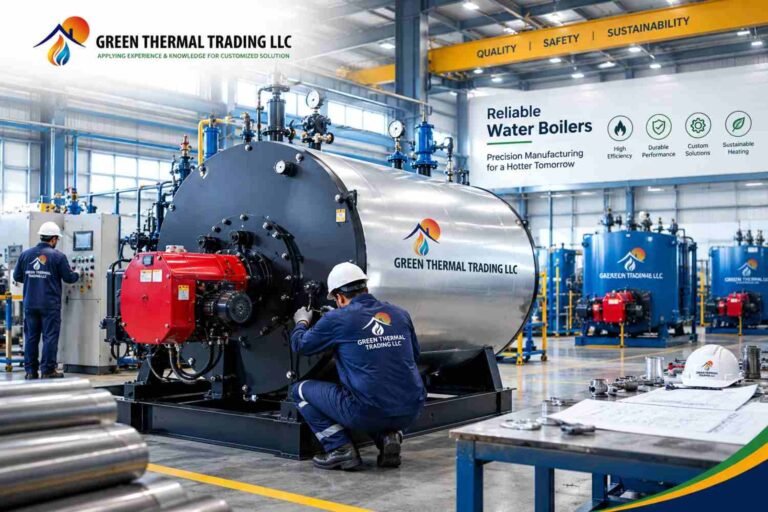
Green Thermal Trading LLC provides heating and hot water solutions designed for commercial and industrial requirements, with a focus on quality, reliability, and application-specific engineering.
Water boilers are heating systems designed to transfer thermal energy to water and produce hot water for domestic, commercial, or industrial use. Depending on the application, a boiler system can be designed to provide a continuous supply of heated water at a controlled temperature.
Modern boilers can be configured according to the required capacity, operating temperature, fuel source, installation area, and hot water demand.
For buildings with high consumption, choosing the right boiler is important because the heating system needs to deliver sufficient output without unnecessary energy consumption.
Manufacturing boilers involves several stages, beginning with understanding the customer’s hot water requirements. A professional manufacturer or supplier evaluates the required capacity, operating conditions, water quality, available space, fuel source, and expected usage pattern.
The first step in manufacturing boilers is determining the application’s heating demand.
Engineers may consider:
This information helps determine the appropriate type and capacity of boilers
Once the requirements are established, engineers develop the boiler configuration. The design may include the heating chamber, water circulation system, controls, insulation, safety components, connections, and other required equipment.
Good engineering ensures that water boilers can operate efficiently while maintaining consistent water temperature.
For commercial applications, properly designed boilers for hot water can also be integrated with storage calorifiers, circulation pumps, heat exchangers, solar water heating systems, or other heating technologies.
Material selection is another important part of manufacturing water boilers.
The materials used must be suitable for the expected operating temperature, pressure, water conditions, and service environment. Depending on the design and application, manufacturers may use specially selected steel or other suitable materials for different components.
The correct material selection helps improve the durability and service life of boilers for hot water.
After engineering and material selection, manufacturing begins with fabrication and assembly.
Components are cut, formed, welded, assembled, and inspected according to the approved design. Manufacturing precision is important because even small inconsistencies can affect system performance.
During this stage, water boilers are assembled with their heating and water-handling components to create a complete system.
For larger commercial and industrial projects, boilers for hot water may be manufactured or configured according to specific project requirements rather than using a one-size-fits-all design.
Manufacturing quality directly affects the performance, safety, efficiency, and lifespan of water boilers.
A well-manufactured boiler should provide stable heating performance and operate reliably under its intended conditions. Poor manufacturing practices, incorrect component selection, inadequate welding, insufficient insulation, or improper assembly can negatively affect system performance.
This is why businesses should consider the manufacturer’s technical capabilities and quality management practices when selecting boilers for hot water.
Green Thermal Trading LLC operates with a focus on quality and professional engineering. The company has an ISO 9001:2015 Quality Management System, supporting its commitment to consistent quality processes.
Testing is an essential part of manufacturing water boilers. Before a system is delivered or commissioned, relevant inspections and tests help confirm that the equipment meets its intended design requirements.
Depending on the system, testing and quality checks can include inspection of:
Proper testing helps identify potential issues before the water boilers are put into regular operation.
For commercial projects, reliable testing is especially important because boilers for hot water may operate for long periods and serve a large number of users.
The UAE has a wide range of commercial and industrial buildings with different hot water requirements. A hotel, hospital, residential tower, factory, or sports facility may have completely different demand patterns.
Therefore, selecting water boilers based only on capacity is not always sufficient.
Businesses should also consider:
Hot water demand: Understanding peak and average consumption helps determine the appropriate boiler capacity.
Operating temperature: Different applications require different hot water temperatures.
Available energy source: The available fuel or heating technology can influence the boiler design.
Space availability: Compact equipment may be necessary where plant-room space is limited.
Energy efficiency: Efficient boilers for hot water can help reduce unnecessary energy consumption during long operating periods.
Maintenance requirements: Easy access to components can make inspection and servicing more convenient.
Hotels require reliable hot water throughout the day for guest rooms, kitchens, laundry facilities, restaurants, spas, and other services.
A properly designed hot water plant using suitable water boilers can help meet fluctuating demand while maintaining consistent water temperature.
For hospitality projects, boilers for hot water can also be integrated with storage tanks and circulation systems to provide hot water efficiently across multiple areas of a property.
Yes. In suitable applications, water boilers can be integrated with solar water heating systems or other renewable-energy technologies.
Solar energy can contribute to water heating during periods of suitable solar availability, while a boiler or auxiliary heating system can provide additional heating when required.
This type of hybrid approach can help businesses improve energy efficiency while maintaining reliable hot water availability.
For UAE buildings, combining solar thermal technology with efficient boilers for hot water can be particularly useful where there is significant year-round hot water demand.
The efficiency of boilers depends on several factors, including equipment design, operating temperature, insulation, maintenance, controls, water circulation, and system sizing.
Businesses can improve boiler performance by:
Proper operation and maintenance can help boilers deliver consistent performance throughout their service life
Professionally manufactured boilers for hot water are designed around specific operating requirements rather than simply providing a standard heating unit.
A professional supplier can help evaluate the application’s requirements and recommend an appropriate system configuration.
This approach is particularly valuable for UAE projects where space limitations, high temperatures, large buildings, and continuous hot water demand can influence system design.
Green Thermal Trading LLC works with commercial and industrial clients to provide hot water and heating solutions suited to different project requirements. From system selection and engineering support to supply and installation considerations, the objective is to provide dependable heating solutions for long-term operation
The manufacturing of boilers involves much more than assembling heating components. It requires proper engineering, material selection, fabrication, assembly, testing, quality control, and consideration of the application’s actual hot water requirements.
For hotels, hospitals, residential buildings, commercial properties, and industrial facilities, selecting the right boilers for hot water can support reliable hot water availability and efficient system operation.
Green Thermal Trading LLC provides professional heating and hot water solutions for UAE projects, helping businesses identify suitable systems based on their specific requirements. With quality-focused processes and experience in water heating technologies, the company supports reliable solutions for demanding commercial and industrial applications.
If you are planning a new hot water system, upgrading an existing installation, or looking for boilers for a commercial or industrial project in the UAE, selecting the right equipment and working with an experienced technical supplier can make a significant difference in long-term performance.
Water boilers are used to heat water for domestic, commercial, and industrial applications. They can supply hot water for hotels, hospitals, residential buildings, factories, restaurants, and other facilities.
Boilers for hot water use a heating source to transfer thermal energy to water. The heated water can then be stored, circulated, or supplied directly to the required application depending on the system design.
The appropriate water boilers for a hotel depend on the hotel’s room count, hot water consumption, peak demand, required temperature, available space, and energy source. A professional assessment is recommended before selecting equipment.
Yes. Boilers for hot water can be integrated with solar water heating systems in suitable applications. Solar energy can provide part of the heating requirement while the boiler provides backup or additional heating when necessary.
The service life of water boilers depends on their construction, operating conditions, water quality, installation, usage, and maintenance. Regular inspection and preventive maintenance can help extend equipment life.